Looking honestly at a painful trading loss takes willingness to learn. If you recognize some of your own decisions here, that willingness is a constructive place to begin.
If this sounds uncomfortably familiar, there’s no hidden camera watching your trading screen. Some very human decisions simply leave remarkably similar footprints.
A trader posts an equity curve that rises sharply and then collapses. The replies arrive quickly: “You’re an addicted gambler. Quit.” The financial damage may be obvious. Its cause usually is not.
There is a serious, testable idea behind a more useful response: a person may begin with selective entries and controlled exposure, then start taking trades to preserve a winning identity, avoid accepting a loss, or restore a previous balance. The decision stops being about the opportunity in front of them and starts being about what they need the next trade to do.
Loss-chasing, emotional reactivity and excessive trading are documented. The research reviewed here does not establish that most social-media account blowups are caused by abandoning a previously profitable system, or that gambling problems explain only a few.
A screenshot cannot reveal complete fills, cash flows, leverage, rule adherence or impaired control. Nor are viral posters a representative sample of traders. The defensible question is: What changed in the decisions and the risk—and what evidence would distinguish the possible explanations?
The urge to recover can change the trade.
1. Professionals also take more risk after losses.
Coval and Shumway examined professional Treasury-bond futures trading at the Chicago Board of Trade using 1998 transactions. After a losing morning, the probability of taking above-average afternoon risk was 31.2%, compared with 27.0% after a profitable morning—a difference of 4.2 percentage points. Their analysis also associated morning losses with more aggressive, price-setting trades.[1]
Source [1] · historical observational study · not a measure of account failure or addiction.
Interpretation: “I need to get back to even” is a plausible route to increased exposure, including among experienced traders. This study does not show that every losing trader behaves that way or prove why a particular account collapsed.
“I just need to get back to even” sounds like a goal. Unfortunately, it isn’t an entry signal. A useful checkpoint is whether the trade still meets your written criteria when the old account balance is taken out of the decision.
2. Gains can alter the frame, too.
In real-money experiments, Thaler and Johnson found that previous gains could increase willingness to accept risk—the house-money effect. Following losses, choices offering a route back to break-even became especially attractive. Responses depended on how the choices were framed; losses did not universally increase risk-taking.[2]
Trading application: treating accumulated profits as disposable “house money,” or the old account peak as a debt the market must repay, can replace a forward-looking decision with an emotional reference point. Applying these laboratory findings to a trading account is an interpretation, not a measured prevalence estimate.
3. Stronger emotional reactions accompany worse performance.
Lo, Repin and Steenbarger enrolled 80 volunteer day-traders in a five-week study. Of these, 69 supplied usable daily mood and trading reports; only 33 supplied valid final questionnaires. More intense emotional responses to both gains and losses were associated with worse normalized trading performance. The selected sample, attrition, self-reported records and correlational design do not establish that emotion caused the losses, or that suppressing all emotion improves returns.[3]
4. Avoiding a realized loss is a measurable pattern.
Odean’s study of 10,000 brokerage accounts found that investors preferred realizing winners to realizing losers. Subsequent performance did not justify that preference. This disposition effect is consistent with some forms of hanging on after a thesis fails; it is not proof that every losing position should be sold or that its owner has an addiction.[4]
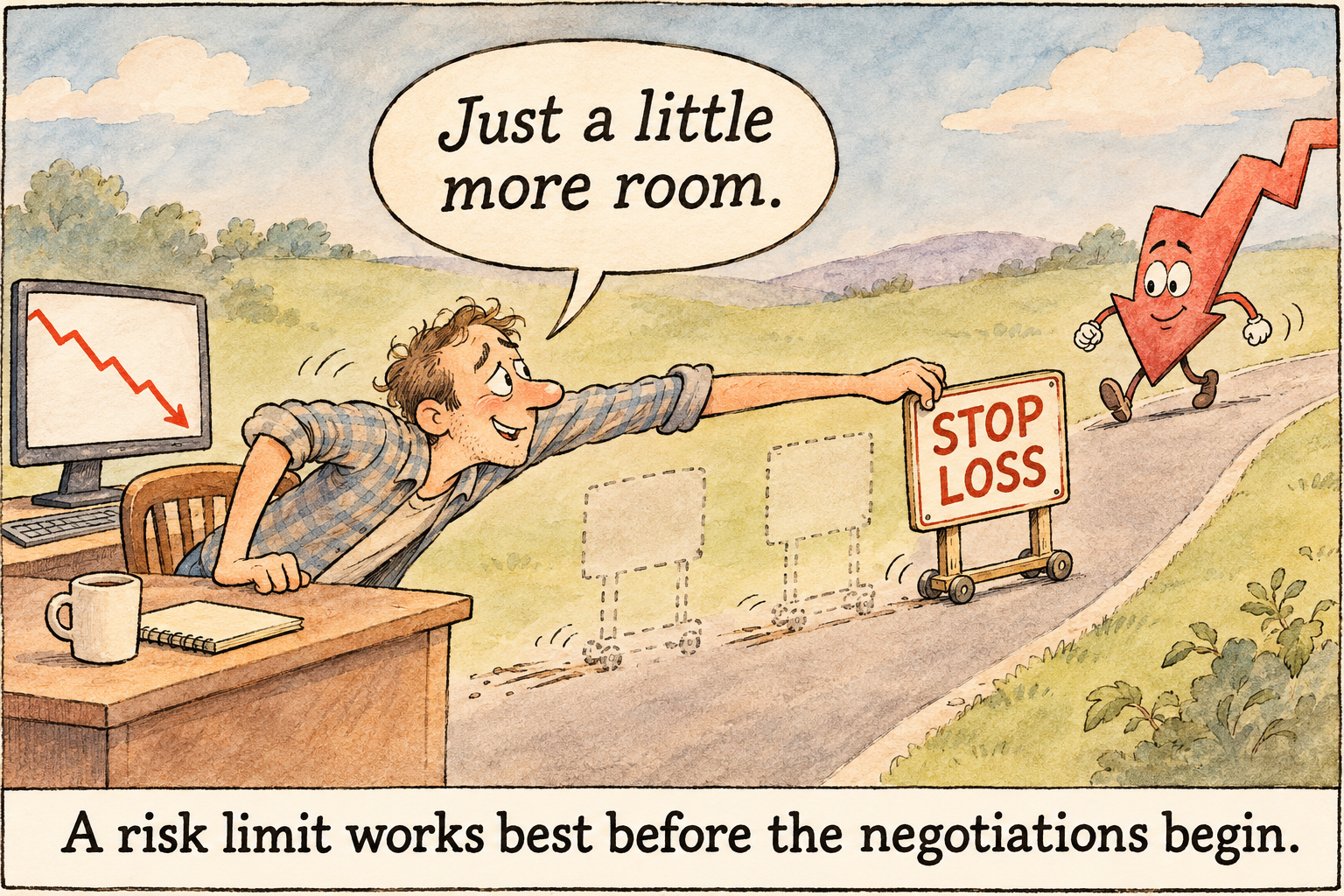
Moving a stop can feel like giving the trade another chance. It also gives the loss permission to grow. Set your risk before entering, and recognize when hope has started rewriting the plan. Review a proposed change against your written rules: widening an exit simply to avoid accepting a loss changes the risk you originally agreed to take.
5. Activity and the environment can add friction.
Barber and Odean studied 66,465 US households from 1991–1996. The most active group earned 11.4% annually after transaction costs, against a 17.9% market return. These historical figures document an activity-related performance penalty, not current expected returns or an account-blowup rate.[5]
Technology can also influence behavior. In a 2024 online experiment with over 9,000 consumers, the UK Financial Conduct Authority tested flashing prices, notifications, leaderboards and reward features. Engagement practices could increase trading frequency and risk-taking. That experiment supports scrutinizing app design; it does not establish that social media caused an individual’s losses or a clinical disorder.[8]
A rising account needs an audit of its own.
The “I stopped doing what worked” explanation may be accurate. But a favorable market, concentrated exposure or a few lucky outcomes can also produce early gains. A rule can look logical and still lack positive expectancy after costs. Returning to it without testing may recreate the same risk.
In Learning, Fast or Slow, using Taiwanese day-trading data from 1992–2006, only the most experienced, previously profitable group earned predictably positive net returns; that group represented less than 3% of active day-traders on an average day. The paper also documented substantial persistence among traders with loss histories.[6]
A separate Brazilian working paper examined people who entered equity-futures day trading in 2013–2015 and persisted for at least 300 days: 97% lost money. This is a specific market and selected persistence group. Losing money is not the same as losing almost an entire account, and neither statistic diagnoses the traders.[7]
These findings make “the old method definitely worked” a proposition to investigate. Compare the original rule’s complete, cost-adjusted record with later exceptions; check whether leverage, conditions or execution changed. If rule-following trades also lose after costs, execution discipline alone is insufficient.
When the concern is loss of control.
Emotional trading and gambling-related harm can overlap. “Fear and greed” is not an alternative explanation that automatically rules out a gambling problem. A 2025 systematic review of 23 theoretical papers cautioned against assuming that the gambling framework fully defines problematic trading, while acknowledging the evidence linking speculative trading and gambling problems.[9]
The American Psychiatric Association describes gambling disorder as a persistent harmful pattern involving impaired control. Warning signs include repeated failed efforts to cut back, concealment, chasing losses and harm to relationships or work. These warrant assessment by a qualified clinician; the size of a loss alone is insufficient.[10]
| Possible problem | What to examine |
|---|---|
| The strategy lacks an edge | Complete rule-following results, realistic costs, unseen periods and market conditions. |
| The trader abandoned the rules | Changes in entry criteria, size, exposure, exits and frequency after wins or losses. |
| Trading is becoming compulsive | Failed attempts to stop, secrecy, persistent harm and inability to respect access limits; seek professional assessment. |
These are investigation paths, not diagnostic categories. More than one can apply. Someone may have used a sound method earlier and still develop a harmful relationship with trading later.
The risk change is what makes the spiral expensive.
Consider this illustrative sequence, not a universal account-blowup model:
- 01A win or loss changes the goal.
The aim becomes defending a peak or erasing a loss.
- 02The trade standard shifts.
An absent setup is rationalized, exposure rises, or an invalidation is ignored.
- 03The next adverse move does more damage.
Concentration, leverage and execution risk magnify the setback.
- 04Recovery pressure feeds the next decision.
The larger drawdown makes “one big trade” feel more urgent.
Size can turn a setback into a crisis.
Both hypothetical accounts begin at $10,000. Every trade loses its entire planned risk, measured against current equity.
Exact model: ending equity = $10,000 × (1 − risk fraction)losses. Synthetic arithmetic, not a backtest or a recommended risk percentage. Excludes costs, gaps and changing size; does not estimate how likely the streak is.
The loss does not have to begin with bad market analysis. Correct direction with excessive exposure can still produce an intolerable drawdown. Conversely, even perfectly executed trades can lose. Evaluate the decision process and the financial outcome separately.
Pause. Audit. Precommit. Protect.
A practical risk-control reminder—not a tested treatment protocol or a promise that trading will become profitable.
- 01Pause the recovery mission.
After a risk-limit breach or an urge to get even, stop new live entries. Do not increase size or make a fresh deposit to chase the old balance.
- 02Audit the rule, then the execution.
Use complete fills and costs. Separate trades that followed a written setup from exceptions. Test the original rule on unseen data; early gains alone are not validation.
- 03Commit before the next order.
Write the entry condition, invalidation, position size, total exposure and session loss limit. A missing setup means no trade. Stops can slip; limits can fail to fill.
- 04Make the limit enforceable.
Use suitable broker controls, remove engagement prompts and review adherence separately from P&L. Consider any return to live risk only after review; persistent loss of control calls for professional help.
Before entering: Would this trade still meet my written rules if I could not see today’s P&L or the old account high?
If repeated attempts to stop fail, or trading is creating secrecy, debt or harm at home or work, stop live speculation and seek a licensed mental-health professional familiar with gambling-related harms. NICE recommends nonjudgmental support, access restrictions and evidence-based psychological care for gambling harms. Brokerage restrictions must match the actual trading access; ordinary gambling-payment blocks may not cover it.[11]
A constructive response to a loss post is curiosity backed by records: What was the rule? Was it followed? Was the risk survivable? Can the person stop? Those questions can guide an honest review and help identify the support or safeguards needed next.
You can take responsibility for a damaging decision without turning it into a verdict on your intelligence or your worth.
You do not have to recover the old balance to take a constructive next step. Pausing, asking for help and protecting what remains are decisions you can make now. If you decide trading is no longer right for you, stepping away can be a successful outcome, too.
Original source material
Checked November 8, 2026. Studies span different markets and eras. Their findings do not identify the cause of a specific social-media post. “Research synthesis” distinguishes empirical findings from this article’s interpretations and practical checklist.
1998 CBOT Treasury-bond futures transaction study. Afternoon above-average risk: 31.2% after morning losses versus 27.0% after gains. Observational evidence in one professional market, not a diagnosis or a count of account blowups.
Real-money choice experiments support context-dependent house-money and break-even effects. Laboratory choices do not establish the prevalence or cause of brokerage account ruin.
80 enrolled, 69 supplied usable daily reports and 33 supplied valid final questionnaires over a five-week study. Stronger emotional reactions accompanied worse normalized performance. Selected sample, attrition, self-reported records and correlation limit inference.
Trading records for 10,000 brokerage accounts show a preference for realizing gains rather than losses, not explained by subsequent performance. Holding a loser alone does not establish compulsive behavior.
66,465 US discount-broker households, 1991–1996. The most active group earned 11.4% annually net of transaction costs versus 17.9% for the market. Historical underperformance is not an account-ruin or addiction statistic.
Taiwanese day-trading evidence, 1992–2006. Less than 3% of active day-traders on an average day belonged to the most experienced, previously profitable group earning predictably positive net returns. Not a present-day universal failure rate.
Brazilian equity-futures entrants from 2013–2015 who persisted at least 300 days: 97% lost money. This is a specific persistent-trader sample; losing money is different from losing an entire account.
Online experiment with more than 9,000 consumers testing four app engagement features. Supports effects on activity and risk-taking, not clinical diagnosis or a causal estimate for social-media loss posts.
Reviews 23 theoretical papers and cautions against assuming the gambling framework defines every case. Also recognizes evidence linking speculative trading with gambling problems. Does not estimate prevalence among social-media loss posters.
Describes persistent impaired control and harms, including failed efforts to stop, concealment and loss-chasing. These signs warrant assessment; an account balance or a comment thread cannot establish a diagnosis.
Recommends nonjudgmental support, practical access restrictions and evidence-based psychological treatment for gambling harms. Gambling-payment blocks may not cover brokerage trading; controls must fit the actual access route.